
Game of Consultants
Our newest initiative yet, Game of Consultants, tests your consulting knowledge & analytical eye to the fullest. Attempt it and see how good you are! We add new ones every week
NOVICE

Why Groups of Experts Watch Disasters Unfold and Let It Happen
Why do disasters unfold in rooms full of experts without anyone stopping them?
Contrary to popular belief, failure is often not a result of ignorance, but of silence. Drawing from psychological research, historical case studies, and organisational behaviour, this article examines how the bystander effect operates inside expert groups, turning warning signs into “open secrets” that no one acts upon.
From NASA’s Challenger disaster to Kodak’s missed digital revolution and the 2008 financial crisis, the piece explains how diffusion of responsibility, pluralistic ignorance, and groupthink prevent individuals from speaking up even when they know something is wrong. The article also explores how organisational design, not individual intelligence, determines whether expertise translates into action.
Read Sanya Agarwal’s article to understand why intelligence without psychological safety can be dangerously ineffective and what organisations can do to break the silence.

Uncovering India’s Coaching Culture
Worth over ₹58,000 crore and enrolling nearly seven million students each year, India’s coaching industry has transformed from supplementary education into a parallel system one that often rivals or even replaces formal schooling.
From Kota to Hyderabad, Delhi to Patna, entire cities now function as coaching ecosystems, driven by high-stakes exams like JEE and NEET. The rise of large offline institutes alongside digital giants such as BYJU’S, Unacademy, and PhysicsWallah has created a 24/7 marketplace built around aspiration, competition, and uncertainty.
But beneath the industry’s rapid growth lies a deeper structural story, one of systemic gaps in education, rising inequality, and mounting emotional strain on students. The expansion of coaching reflects not just market demand, but also policy failures and a cultural obsession with exam ranks as the sole measure of merit.
Read Aayaan Gambhir’s article for a comprehensive analysis of the economics, psychology, social consequences, and reform pathways of India’s coaching ecosystem.
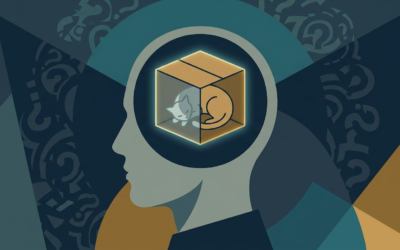
The Schrödinger’s Cat Within Us
Many individuals live with unresolved thoughts that exist in a state of uncertainty, much like Schrödinger’s famous paradox. We often avoid confronting fears, doubts, and possibilities because ambiguity feels safer than definitive outcomes. This psychological tendency manifests through cognitive biases such as analysis paralysis, the planning fallacy, and avoidance rationalisation.
The article explores how the human mind negotiates with uncertainty, creating defence mechanisms that delay introspection while maintaining an illusion of control. By drawing upon frameworks like metacognition, the placebo–nocebo dynamic, and Bandura’s concept of self-efficacy, the piece argues that personal growth begins when individuals dare to “open the box.”
Read Zoya’s article to understand how uncertainty is not merely a paradox to resolve but an invitation to discover the resilience of the human mind.

The ‘Michel-angelo’ Effect: The Art of Humanangelo-ing
What if personal growth isn’t a solitary pursuit, but something shaped carefully and continuously by the people around us?
Drawing inspiration from Renaissance sculptor Michelangelo, the Michelangelo Effect explains how close relationships help individuals grow into their ideal selves through affirmation, belief, and behavioural support. First introduced in academic psychology in 1999, the theory suggests that partners, mentors, friends, and even parents act as sculptors chiselling away self-doubt to reveal hidden potential.
From friendships and families to boardrooms and mentorship programs at firms like Deloitte and Sun Microsystems, the Michelangelo Effect finds relevance far beyond romance. Yet, it also carries a paradox: when affirmation turns into control, growth risks becoming conformity.
Read Raghav’s article, for a deep dive into the psychology, applications, and limitations of this powerful theory of human development.
Guesstimate the Total Monthly Spend on Gym Memberships in Delhi
Let’s Guesstimate the total monthly spend on gym memberships in Delhi.

Who really benefits when the world can’t sleep?
Sleeplessness is no longer just a personal problem; it’s an economic engine. As cities stay awake past midnight, a parallel economy comes alive, monetising every restless hour through food delivery, streaming, e-commerce, pharmaceuticals, and digital platforms.
From autoplay episodes and midnight flash sales to on-demand food and sleep “solutions,” modern businesses don’t just serve insomniacs; they actively design systems that keep people awake longer. In a world where attention is currency, fatigue has become profitable.
As late-night consumption surges, a deeper question emerges: can companies participate in the sleepless economy without exploiting vulnerable, tired consumers?
Explore this sharp analysis in Ridhimaa Mangaal’s article.