
String of Pearls vs Necklace of Diamonds
“The Indian Ocean is the key to the seven seas”
~Alfred Mahan
Indian Ocean: The Maritime Chessboard
India and China, two of the most influential powers of the twenty-first-century global paradigm, have long been arch-rivals in the race to become Asia’s dominant superpower. However, this geopolitical rivalry goes beyond just trade or land conflict; the two nations are engaged in a strategic battle to gain control in the maritime domain. This competition is most visible in the Indo-Pacific region, where both countries are building alliances and infrastructure to counter each other. China, under its Belt and Road Initiative (BRI), has developed a network of ports and military bases to secure China’s trade routes and encircle India. This strategic manoeuvre of China is popularly known as the ‘String of Pearls’ Strategy. India, on the other hand, has adopted the strategy of ‘Necklace of Diamonds’ to counter increasing Chinese influence in the Indian Ocean by forming alliances and military partnerships.
The Indian Ocean has emerged as the epicentre of global power politics in the 21st century. With 8% of the global maritime trade and 40% of global oil shipments passing through the Indian Ocean, gaining control over these waters can give a nation substantial influence over global commerce and energy. Three of the most pivotal global maritime chokepoints – Strait of Hormuz, Strait of Malacca, and Bab El-Mandeb Strait are present in the Indian Ocean only. These reasons induced both nations to invest heavily in infrastructure development and develop alliances. However, what began as a set of economic partnerships has gradually evolved into a multi-dimensional struggle for geopolitical primacy, access, and influence.
The String of Pearls
China wants to be the leading superpower in the world; ergo, they are expanding markets, business, trade and other facilities in different countries. They have already undertaken the Belt and Road Initiative (BRI), which is concerned with global infrastructure and economic development, and aims to invest in over 150 nations and international organisations. The string of Pearls is a part of the Border and Road Initiatives, which is mainly a geopolitical strategy to build commercial facilities and establish military networks and bases across the Indian Ocean to encircle India and gain strategic control over the waters. China doesn’t have any openings in the Indian Ocean. The Strings of pearls, however, will allow China to surround India and thus be able to dominate it. Myanmar, Bangladesh, Sri Lanka, Pakistan, the Maldives and Djibouti together form the major pearls of China.
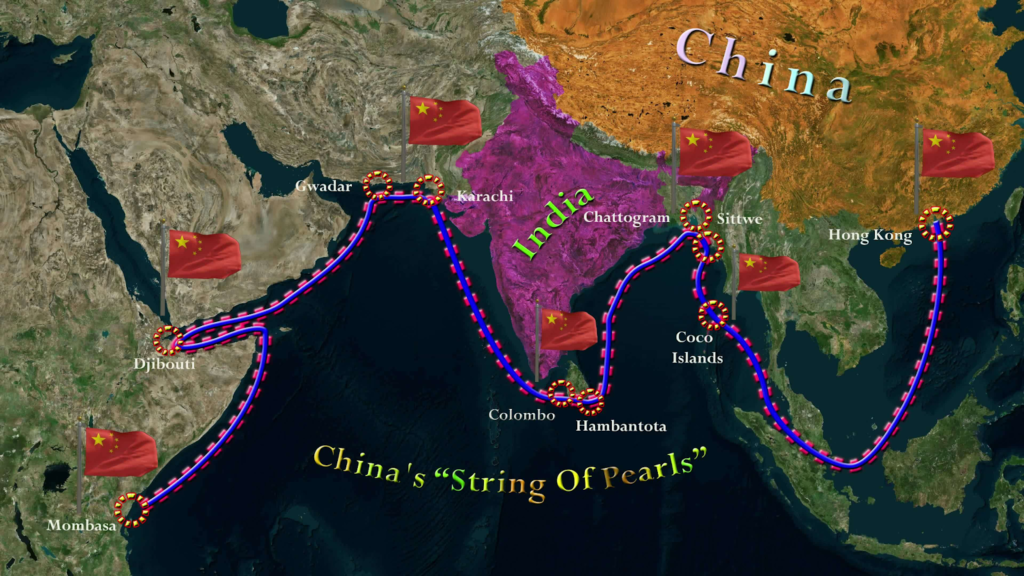
China’s String of Pearls Strategy
Both Myanmar and Bangladesh have taken a pro-China stance after military coups in the two nations. In Myanmar, the Chinese Army is constructing a base on the small Coco Island, which connects the Indian Ocean and the Andaman Sea north of India’s Andaman Islands, whereas in Bangladesh, China has developed the Chittagong Port for faster transit of commercial activities in the Bay of Bengal. By the ‘string of pearls’ strategy, China is not only making its presence in the Indian Ocean, but also capturing strategic locations through debt-trap diplomacy. Srilanka is the burning instance of it, the island country had to hand over the Hambantota port (estimated cost – $360 million) to China for 99 years because of failure of loan repayment.
Pakistan is a long-standing ally of China. Both China and Pakistan have come together to develop the China-Pakistan Economic Corridor (CPEC), which is an essential part of the BRI project. China has invested a huge sum of money in Pakistan’s infrastructural development, selling arms and weapons, and lending loans. Therefore, owing to Pakistan’s dependence on Chinese investments and foreign aid, Pakistan has become China’s puppet to keep India in check. China has total construction and operating access to the Gwadar Port. The port is being used not only for the purpose of CPEC but also for military purposes, which is a concern for India’s national security.
The Necklace of Diamonds
India has been creating its own “Necklace of Diamonds” to counter the Chinese “String of Pearls”. Rather than replicating China’s state-financed infrastructure model, India’s approach emphasises strategic partnerships, access agreements, and multilateral cooperation. The Diamonds of the Necklace comprise Indonesia, Singapore, Iran, Vietnam, Japan, Seychelles, Mongolia and Oman. This strategy aims at circumscribing China, which, in its basic essence, is the counter-encirclement strategy of India. India has been expanding its overseas bases and has been actively focusing on improving relations with key countries in the Indian Ocean to counter China’s influence.
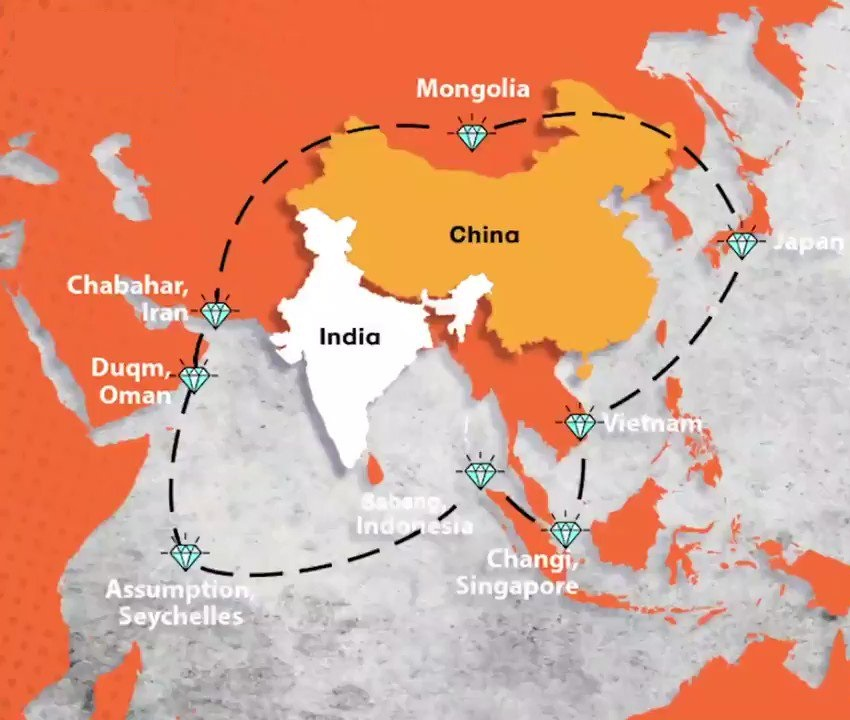
India’s Necklace of Diamond’s Strategy
Launched in 2014, the Act East Policy was an upgrade of the Look East Policy, focusing on improving economic cooperation, cultural ties, and a strategic relationship with the Indo-Pacific region. Its purpose was to integrate the Indian economy with Southeast Asia. When India launched the ‘Look East Policy’ in 1992, its trade with the Association of South-East Asian Nations (ASEAN) was $2 billion, and now the trade has grown to $72 billion. The policy is a cornerstone of the Necklace of Diamonds strategy. The policy has been instrumental in forming alliances and strategic agreements with Vietnam, Singapore, Japan, the Philippines, Indonesia, and Thailand, facilitating India’s influence in the Indian Ocean.
India has been helping Indonesia to build the Sabang Port. It has strategic significance as it is located right at the entrance of the Strait of Malacca and India’s Andaman & Nicobar Islands. This strait is one of the most famous maritime choke points. A large portion of the global trade, especially that of oil, goes to China through this region. Control over the chokepoint gives India a strategic advantage. India is also building the Chabahar Port in Iran, acting as a counter to Pakistan’s Gwadar Port. The Iranian Port serves as a gateway to Central Asia for India, which is blocked in landways due to Pakistan and China to the North. India also has acquired the Duqm port in Oman, providing access to another maritime chokepoint – the Strait of Hormuz.
India has also focused on improving strategic cooperation with nations. Prime Minister Narendra Modi became the first Indian Prime Minister to visit Mongolia, catalysing trade between the two nations. Prime Minister Modi also visited all 5 countries of Central Asia – Kazakhstan, Uzbekistan, Kyrgyzstan, Turkmenistan and Tajikistan in one go and became the first Indian Prime Minister to do this. Within 4 years, trade with Central Asian countries has doubled after his visit. Vietnam and the Philippines have also maintained strong relations and are two of the largest buyers of the BrahMos Missile. Additionally, India has a quadrilateral agreement with Australia, Japan and the United States for military co-operation in the Indian Ocean. The alliance between the four nations is popularly known as the QUAD. The main aim of the alliance is to counter the rising influence of China in the Indian Ocean. The QUAD alliance has conducted multiple joint naval military drills in recent years to deter any Chinese aggression.
Strategic Challenges
Both the strategies face structural constraints. For China, the growing backlash against debt burdens and sovereignty concerns threatens the sustainability of its maritime network. The Hambantota lease has become a symbol of “debt-trap diplomacy”, eroding China’s image and inviting calls for greater financial transparency. Pakistan’s economic and political fragility, along with independence demands and uprisings in Balochistan, also raises questions about the long-term viability of CPEC. For India, the principal challenges are of scale and coordination. Building alliances requires patience and consensus. Funding infrastructure through partnerships is slower than unilateral investment. Balancing assertive maritime policy with the traditions of non-alignment remains a delicate task. The investments made by India are also much lower compared to China. China has invested around $60 billion in the development of CPEC alone, while India’s largest investment totals just $8 billion in developing Chabahar port in Iran.
From a consulting standpoint, both nations are essentially implementing supply-chain risk mitigation strategies under different models. China is focusing on obtaining strategic autonomy in the global trade paradigm, whereas India is focusing on preserving open sea governance through collective deterrence. Each strategy carries execution risks; China’s is sustainability risk, India’s is scalability risk.
Policy Recommendations & The Way Forward
China has created a perception of coercive influence owing to its Debt Trap Diplomacy. Moving forward, the imperative for China lies in rebranding its BRI by increasing financial transparency to induce more nations to join the BRI. Further, they need to focus on deepening existing assets rather than pursuing new acquisitions. For instance, the Pakistani Gwadar port lies in the province of Balochistan, where there has been increasing resistance by the local communities due to fear of rising foreign influence. The people of Balochistan demand secession from Pakistan and have ambushed the development of CPEC several times in the past few years, which has led to the project coming to an impasse. Overcoming these hurdles is the need of the hour for China.
India, on the other hand, will have to work on developing a proper mechanism for funds allocation and management. This is essential for proper funds allocation, avoiding potentially straining relations with allies. For instance, Iran proceeded with the Chabahar-Zahedan railway line project by itself, citing delays in funding by India. Similar to India, ASEAN also faces conflicts with China, most prominent being the South China Sea conflict, where China claims authority over the maritime space belonging to the ASEAN nations. With multilateral cooperation and strategic collaborations, ASEAN and India can together counter the Chinese influence in the Indo-Pacific.
The contest between China’s String of Pearls and India’s Necklace of Diamonds is more than just a mere rivalry, it is a struggle over the power structures that will reshape the Indian Ocean in the decades ahead. Both the nations stand at an inflection point: China needs to evolve from assertive expansion to credible stewardship, while India must use its geographic advantage to strengthen institutional leadership and foreign ties. The future of the Indian Ocean will not be determined by the number of ports or bases, but rather by which power can build a network rooted in trust, transparency, and growth, the true currency of the twenty-first-century.
References
India’s necklace of diamonds as a counter strategy to the Chinese string of pearls: Comparative analysis. (2022). International Journal for Research Trends and Innovation, 7(10), 163–164. https://www.ijrti.org
Parikh, A., & Kureshi, B. (2024). The necklace of diamonds and string of pearls: The duo counter-reactive game that dominates the world. GLS KALP: Journal of Multidisciplinary Studies, 4(3), 1–14. https://doi.org/10.69974/glskalp.04.03.78
Necklace of diamonds vs string of pearls: India-China standoff. (2022, June 23). Times of India Blog. https://timesofindia.indiatimes.com/readersblog/youthwrites/necklace-of-diamonds-vs-string-of-pearls-india-china-standoff-43458/
Journal, S. A. (2020, September 28). ‘String of pearls’ vs ‘necklace of diamonds’ strategy. Southeast Asia Journal. https://southeastasia-journal.com/archives/5680
Chronicle, P., & Chronicle, P. (2025, February 14). The string of pearls vs. the necklace of diamonds: India and China’s battle for influence. The People Chronicle – Unveiling Stories of Art, Society, and Power. https://thepeoplechronicle.com/india-vs-china-influence