
The 180 Pulse
With thought-provoking articles covering varied domains, 180DC SRCC aims to create student leaders through a holistic learning experience.
Read to take a deep dive into looking at world issues from the eyes of a consultant.
BUSINESS AND FINANCE

Should Brands Chase Gen Z Trends or Should They Ignore Them?
Why do brands strive for viral visibility today only to become irrelevant tomorrow?
As brands increasingly rely on memes and social media trends to attract Gen Z, this article explores why fleeting digital engagement rarely translates into lasting loyalty or sales. Drawing on insights from Kantar, NielsenIQ and Google, alongside founder-led models like Nish Hair, the article highlights the importance of authenticity and meaningful value. It also presents five key questions brands should consider before embracing a trend.
Read Devanshi Garg’s article to understand how businesses can navigate shifting consumer preferences and build enduring market relevance.

Why Groups of Experts Watch Disasters Unfold and Let It Happen
Why do disasters unfold in rooms full of experts without anyone stopping them?
Contrary to popular belief, failure is often not a result of ignorance, but of silence. Drawing from psychological research, historical case studies, and organisational behaviour, this article examines how the bystander effect operates inside expert groups, turning warning signs into “open secrets” that no one acts upon.
From NASA’s Challenger disaster to Kodak’s missed digital revolution and the 2008 financial crisis, the piece explains how diffusion of responsibility, pluralistic ignorance, and groupthink prevent individuals from speaking up even when they know something is wrong. The article also explores how organisational design, not individual intelligence, determines whether expertise translates into action.
Read Sanya Agarwal’s article to understand why intelligence without psychological safety can be dangerously ineffective and what organisations can do to break the silence.

Uncovering India’s Coaching Culture
Worth over ₹58,000 crore and enrolling nearly seven million students each year, India’s coaching industry has transformed from supplementary education into a parallel system one that often rivals or even replaces formal schooling.
From Kota to Hyderabad, Delhi to Patna, entire cities now function as coaching ecosystems, driven by high-stakes exams like JEE and NEET. The rise of large offline institutes alongside digital giants such as BYJU’S, Unacademy, and PhysicsWallah has created a 24/7 marketplace built around aspiration, competition, and uncertainty.
But beneath the industry’s rapid growth lies a deeper structural story, one of systemic gaps in education, rising inequality, and mounting emotional strain on students. The expansion of coaching reflects not just market demand, but also policy failures and a cultural obsession with exam ranks as the sole measure of merit.
Read Aayaan Gambhir’s article for a comprehensive analysis of the economics, psychology, social consequences, and reform pathways of India’s coaching ecosystem.
SCIENCE AND TECHNOLOGY

The Cascade of Closure: Analysing NASA’s Shutdown Impact on Global Economic and Scientific Progress
When political deadlock on Earth brings space exploration to a halt, the consequences extend far beyond grounded missions and silent laboratories. The 2025 shutdown of NASA revealed just how fragile global scientific progress and economic ecosystems can be when they hinge on government stability, disrupting research, delaying international collaborations, and unsettling thousands of lives tied to the space economy.
What appears to be a budgetary impasse unfolds into a far-reaching crisis—impacting global projects like NISAR, weakening trust in long-term partnerships, and triggering economic slowdowns in communities dependent on space infrastructure. From stalled innovation to furloughed scientists and shaken investor confidence, the ripple effects highlight how deeply interconnected science, economy, and policy truly are.
Yet within this disruption lies a shifting global dynamic. As uncertainty clouds NASA’s reliability, agencies like ISRO may find new opportunities to emerge as stable and strategic leaders in the evolving space landscape.
Explore the full analysis in Sanjana’s article.

The Prancing Horse hits a hurdle: What is Happening to Scuderia Ferrari?
Ferrari remains one of the most powerful brands in the world on and off the track. While the company continues to post strong financial results and preserve its aura of exclusivity, its Formula One team has struggled to convert legacy into consistent championship contention.
Despite podium finishes and historic success, Scuderia Ferrari has fallen short in the modern F1 era, battling technical unpredictability, strategic missteps, and internal coordination failures. In a sport where milliseconds define success, these cracks have proved costly.
Motorsport remains central to Ferrari’s identity, innovation pipeline, and brand value. As new regulations approach and competition intensifies, the Scuderia faces a defining moment: adapt decisively or risk letting its racing heritage erode.
Explore the full analysis in Shashwat Mathur’s article.

Is AI Ironically Killing Productivity?
The excitement surrounding AI adoption is natural due to its remarkable capabilities. It can summarise documents, analyse data, generate marketing content and much more in just a matter of seconds. Companies expected this to free their employees from mundane, repetitive tasks, allowing them to focus on creativity and innovation.
However, it has resulted in a rather disappointing trend in workplaces, i.e. AI-led inefficiency. The enthusiasm can be clearly seen in the sky-high valuations and inflow of investments in the AI space. However, there is a paucity of encouraging outcomes.
The gap in the expectation and the reality of AI-led productivity is not because AI as a tool is completely ineffective. It is, in fact, due to ineffective use of technology in the workplace for a myriad of reasons.
Read Kashvi’s article to discover the entire story.
ECONOMIC AND PUBLIC POLICY

The Invisible Auction: How Attention Funds a Trillion Dollar Industry
Every time you open a social media app, an invisible financial marketplace springs into action auctioning your attention in milliseconds to advertisers competing for a fragment of your focus. What appears to be a harmless scroll is, in reality, the foundation of a trillion-dollar industry built on monetising human attention.
As AI accelerates content production and digital platforms compete for increasingly limited human focus, the pressure to capture and retain attention intensifies. The result is an economy where users rarely perceive themselves as participants, even as their most finite resource time is continuously extracted and traded.
Dive deeper into Vedika’s article to know more about the marketplace.

The Business of Dying: Why Death is a Trillion-Dollar Industry
Death is often treated as a deeply personal experience, yet behind every funeral, cremation, and insurance claim lies one of the world’s most resilient industries. From funeral homes and cemeteries to grief tech and cryonics, the business of death has evolved into a global market worth trillions of dollars.
What appears to be a sacred ritual is also a highly structured commercial system shaped by corporate consolidation, pricing power, and emotional vulnerability. Families navigating grief are often pushed into costly decisions, while investors increasingly view death care as one of the most dependable sectors in the economy. As cremation rates rise and traditional funeral models face pressure, the industry is rapidly reinventing itself through personalised memorials, AI-driven digital afterlives, and emerging preservation technologies.
The economics of dying reveal far more than how societies handle loss – they expose how commerce, technology, and inequality continue to shape the human experience even in death.
Explore the full analysis in Vithurna’s article.

Is Lipstick a Recession Indicator?
Even in times of economic downturn, consumer spending does not disappear—it transforms. The “Lipstick Index,” a concept coined during recessionary periods, reveals how individuals shift from large, deferrable purchases to affordable indulgences or “micro-luxuries” that provide comfort, control, and a sense of normalcy amid uncertainty.
Rooted in consumer psychology, these small purchases—from cosmetics to streaming subscriptions—serve as emotional coping mechanisms, reflecting a deeper need for self-reward during financial stress. For businesses, this shift presents a strategic opportunity: success during a recession depends not on selling necessity, but on offering accessible moments of escapism and reassurance.
From cinema experiences to innovative campaigns like Hyundai’s assurance program, brands that align with consumers’ emotional needs can not only survive but thrive during downturns.
Explore the full analysis in Anna’s article.
Philosophy and Psychology

Words for What We Feel: Wittgenstein and the Psychology of Emotional Granularity
Why do we always default to saying “I’m fine” when things are actually a lot messier underneath?
Contrary to what most people think, using a tiny handful of words for our feelings isn’t just a harmless habit; it actually changes how we handle stress and tough days. Pulling together philosophy, brain science, and psychology, this article looks at how giving our emotions specific names helps turn overwhelming panic into something we can actually manage.
Read Raghav Singhal’s article to find out why precision beats forced optimism every time, and how expanding your emotional vocabulary can actually give you a bit more breathing room on hard days.
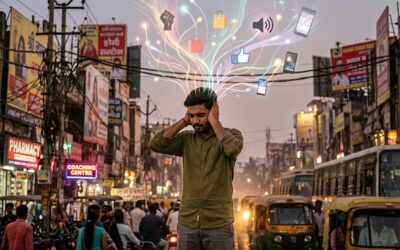
Too Loud to Ignore
India today is louder than ever before. Louder weddings, louder streets, louder politics, louder ambition. But beneath the chaos lies something deeper: a civilisation that entered modernity too fast and never learned restraint along the way.
The article explores how scarcity, rapid economic liberalisation, collective culture, and the desire to finally be seen transformed India into a society that experiences everything at full volume. From overcrowded streets and blaring loudspeakers to the psychology of public life, India’s overstimulation is traced back to something far deeper than noise itself.
Read Kanak’s article to understand why modern India feels so overwhelming and why, after generations of being unheard, the country’s first instinct was never going to be silence.

The Schrödinger’s Cat Within Us
Many individuals live with unresolved thoughts that exist in a state of uncertainty, much like Schrödinger’s famous paradox. We often avoid confronting fears, doubts, and possibilities because ambiguity feels safer than definitive outcomes. This psychological tendency manifests through cognitive biases such as analysis paralysis, the planning fallacy, and avoidance rationalisation.
The article explores how the human mind negotiates with uncertainty, creating defence mechanisms that delay introspection while maintaining an illusion of control. By drawing upon frameworks like metacognition, the placebo–nocebo dynamic, and Bandura’s concept of self-efficacy, the piece argues that personal growth begins when individuals dare to “open the box.”
Read Zoya’s article to understand how uncertainty is not merely a paradox to resolve but an invitation to discover the resilience of the human mind.